



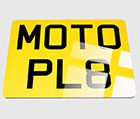
Product specs
- Fully Legal on UK roads
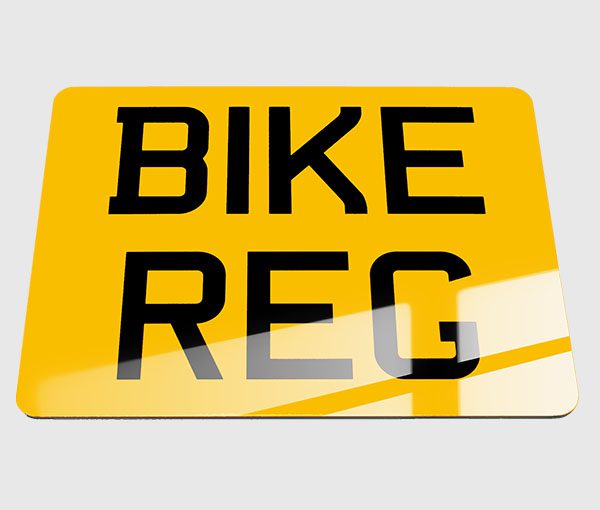
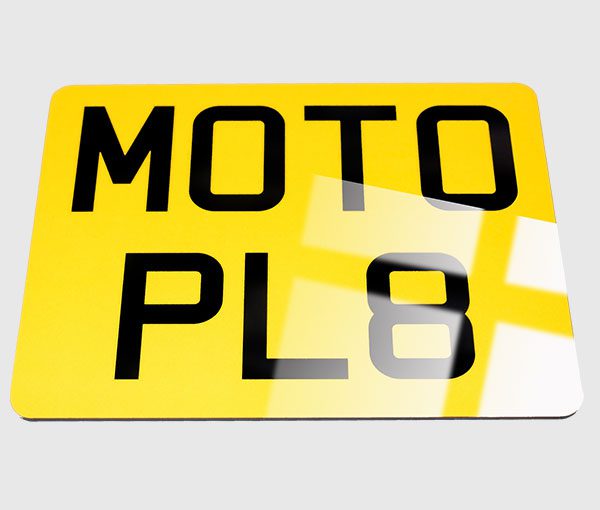
- Correct plate sizing as outlined by the DVLA for motorcycles (9 inches x 7 inches)
- Fully compliant with British standards BS AU 145e
- Premium grade acrylic
- Glossy finish
- Sun fade and water resistant
- Pressure washer resistant
- Fully reflective
- Customisable designs with borders and badges
- Easy fitting
- Same-day dispatch
Motorcycle Number Plates
Our motorcycle number plate maker allows you to tailor your plate according to your specifications, and we’ll have it dispatched on the same day. At MyReg, we understand the importance of finding plates that work for you and your motorcycle. Using our expertise and knowledge, we can provide plates that tick every box and keep you road legal.
Distinguishing Motorcycle Plates from Car Plates
While car and motorcycle number plates may seem quite similar, they do have their distinct characteristics. The basic structure of the registration is the same, allowing for the transfer of a car number plate onto a motorcycle and vice versa, provided it’s not a one-line plate. Motorcycle number plates are typically spread across two lines, unlike the longer plates commonly seen on standard-issue cars. These motorcycle plates consist of two geographical registration area letters, two numbers serving as the age identifier, and three random letters, with the latter three positioned below the former four on the bottom line.
Sizing Matters in Motorcycle Plates
When it comes to the size of motorbike number plates in the UK, people often debate whether small number plates are too small or not. While there is no definitive answer to this question, it is clear that it must be within legal limits. By ensuring your characters are 64mm high, 44mm wide, with a 10mm stroke, and maintaining a 10mm gap between each character, you are meeting legal requirements. This regulation applies regardless of the overall plate size, except for characters ‘1’ or ‘I,’ which are exceptions to the rule.
Commonly, motorcycle number plates come in the size of 229mm x 178mm (9”x7”), but if you’re looking to make a statement with a larger plate or go for a more compact design, you have the creative freedom to do so. Our sizes start from a pocket-sized 152mm x 102mm (6” x 4”), catering to various needs. However, when selecting a legal plate, we offer the standard 9” x 7” size.
Ensuring Your Motorcycle Plates Are Road-Legal
To maintain the legality of your motorcycle number plate, regular maintenance is essential. It involves ensuring your plate remains in a roadworthy condition, free from dirt, cracks, marks, or screws that could alter the appearance of the lettering. While motorcycles are only required to have a rear plate, it’s recommended to install one, considering the potential hazards of front plates, often referred to as ‘pedestrian slicers’ in collision scenarios.
For a motorcycle number plate to be road-legal, it should be fully reflective, featuring black lettering in the “Charles Wright 2001” font on a yellow background. If you opt for a front plate, a white background is also permissible. Motorcycle enthusiasts looking to add a touch of sophistication to their bike often choose 3D fonts to enhance the appearance. Additionally, you have the option of a border, with a selection of five colours available, and a badge, which must be a pre-approved flag with no deviations from the standards.
Classic Motorcycle Number Plates in the UK
It is no secret that some motorcycles don’t sport the standard yellow rear plate, with a black and silver alternative common with dated bikes. Under UK law, motorbikes older than 40 years are exempt from a number of DVLA regulations, known as the historic vehicles class, used in an effort to preserve historic vehicles. Those which meet the specification are also exempt from getting MOTs and paying vehicle tax, providing it has been free of ‘substantial changes’ within the last 30 years, with the DVLA giving examples of a replacement ‘chassis, body, axles or engine to change the way the vehicle works’, although the vehicle does still need to be a roadworthy condition, with £2,500 and 3 points at stake if your bike is in a dangerous condition.
Being exempt from regulations is an effective way of encouraging the preservation of historic vehicles – many of which would rival contemporary bikes – with appropriate number plates which reflect the era in which it was built, such as archaic or retro plates, that won’t stick out as an eye-sore.
Other perks on offer for historic vehicles include an exemption from ‘ULEZ’ and ‘LEZ’ – London’s ultra-low and low emissions zone, which carries a hefty fee if the vehicle doesn’t meet the Euro IV emissions standard.
A Glimpse into the History of Motorcycle Number Plates
The history of motorcycle number plates in the UK is a fascinating journey. Dating back to the 1903 Motor Act, just five years after Triumph Motorcycles began manufacturing motorbikes in England, number plates lacked dates until the introduction of the 1920 Roads Act. During this period, separate registers existed for cars and motorbikes, leading to identical number plates in the same areas.
In 1963, a significant transformation occurred with the introduction of dates on number plates and the centralisation of all registrations. The year 1984 marked another milestone when the format began to resemble what we see today, with a letter denoting the year of registration (e.g., ‘A’ for 1984) and an area code. The modern regulations we abide by today were introduced in 2001, marking the beginning of a new era for motorcycle number plates.
Motorcycle number plates are more than just identifiers; they are unique and they give your bike its own personality. If you are looking for new motorcycle number plates, MyReg has all that you need, and we deliver our plates rapidly, giving you the opportunity to transform the look of your motorcycle in no time at all.